
Seven Questions: Misha Mansoor
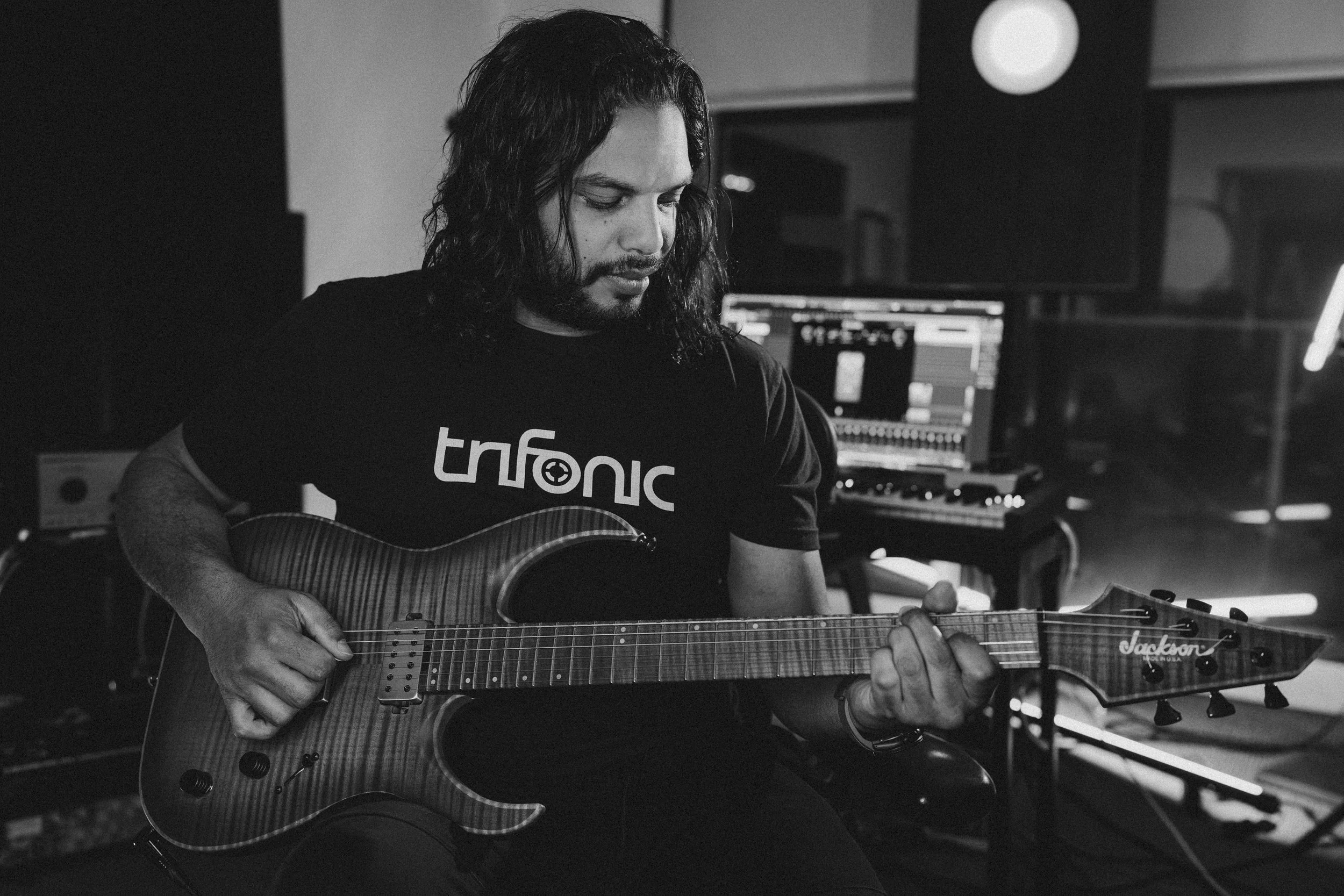
This is Seven Questions About Creativity, a series where we present creatives from all disciplines with a fixed collection of seven questions about their creative processes and experiences. The questionnaire is designed to provide an open space where both broad strokes and specifics are welcome, where creativity is seen through the most universal lens possible, and where you may just find a new way of thinking about your own work.
In this installment, one of the most restless creatives we know, Misha Mansoor, tackles the questionnaire. Misha is the influential guitarist, songwriter, and producer best known as the founder of paradigm shifting prog-metal band Periphery. Misha is also a partner and developer with the innovative virtual drum software company Get Good Drums, the guitar equipment company Horizon Devices, owns and helps curates the record label 3 Dot Recordings, and is involved in the specialty coffee world as a partner in Golden Lantern Coffee Roasters.
Whether it be the music he creates or the tools he’s helped develop to make it, Misha’s world is one where a creative, considered, and independent approach is always be applied. Even within idioms like heavy metal and guitar design—which are deeply rooted in tradition and famously resistant to change—Misha always adds something new to the conversation.

Where do you go, physically or mentally, when you need inspiration?
I usually try to do something completely different. Maybe this is why I have so many other hobbies, but if I'm after musical inspiration and I feel like my tank has run dry, I'll focus on cars, or coffee, or video games or photography. Basically anything other than music, and I find that's a very effective way to refill the creative tank.
“For quite a while I was doing as much as I could with as little as possible, and I don't feel like that ever negatively impacted my creativity.”
How do you recognize when an idea is worth pursuing?
I honestly think it's always worth pursuing an idea—at least initially. I have had so many pleasant surprises where seemingly silly or weaker feeling ideas have evolved into something special. With that said, I'd say it's important to know when to quit or move on. I do have a rule that it is always supposed to be fun. The moment it starts to feel like I'm just spinning my wheels, I'll take a break or even move on to something else. But I do think there is definite value in pursuing that initial idea until it feels like you are really hitting a wall.
What role do constraints (time, budget, tools, rules) play in your creativity?
I probably have ADHD, and I seem to love creating artificial time constraints for myself. I don't necessarily recommend this at all, but, weirdly, those moments have often yielded good results. Budget, tools and rules have always helped with creativity for me. For quite a while I was doing as much as I could with as little as possible, and I don't feel like that ever negatively impacted my creativity. Sometimes constraints can help with option paralysis. I definitely have an issue with procrastination, and the dynamic that ensues yields positive results, at the cost of my sanity sometimes. It's not my favorite dynamic, but I'm not an expert on how to switch out of this dynamic, and with it functioning for me I haven't had much of a reason to change. Sometimes I'll try to get an idea done earlier, but I do feel like it does open me up to a lot more option paralysis, weirdly.
How does collaboration, or solitude, shape your work?
I much prefer collaboration personally. I don't always have the luxury of that, and I do feel like I'm capable alone, but as long as the writing chemistry is there, collaboration is always more fun and exciting to me. Generally, good collaboration yields something that is more than the sum of its parts, and I enjoy that magic.
Misha plays through ”Zuffenhausen” with friend and fellow progressive guitar disruptor Tosin Abasi.
How do you know when a work is finished (or when to let it go)?
This is a tough one. I think with time and experience I have learned to let things go. Learning to abandon art is a skill that I am still trying to master, but I am certainly better at it these days. I'd wager that this develops naturally for most people with enough time. I do remember re-recording my band's first album entirely because I wanted it to be "perfect" or maybe just better in some way, but the original version wasn't bad. It was just different. I don't really think I would do something as extreme as that these days. Maybe that’s a measure of progress?
“You likely started nurturing your creativity because it was a fun pursuit. Sometimes that can inadvertently fall by the wayside. So just remember to have fun with it.”
What advice would you give about how to sustain a creative life?
Just remember to have fun. It's supposed to be fun. You likely started nurturing your creativity because it was a fun pursuit. Sometimes that can inadvertently fall by the wayside. So just remember to have fun with it. All of my business ventures started off as passions, and this is very helpful for when it gets tough or starts to feel like work, because it's still a passion play at its core, and that can be what keeps you going in those tougher moments.
Misha gives a short class on composing with templates as a way to fuel creativity.
What’s been inspiring your creativity lately?
I have to create product demos for GGD, a drum software company of which I am one of the owners. These demos really just need to showcase our drums in an appropriate context—they don't need to be mind-blowing or to reinvent the wheel. I call these "low responsibility ideas" and I really just don't try so hard when I'm writing these. This has turned out to be an absolute gift. Sometimes not overthinking and just letting instinct or the first idea run wild can yield really interesting results. Learning to loosen the grip can allow the creativity to flow a bit more freely. Upon reflection, it does make sense, but I don't have an easy way to trigger this for more important projects as they have a weight to them that is hard to ignore. So I really do embrace opportunities to write my low responsibility ideas.
